David Marcus: “We will quickly develop the phone function in Facebook Messenger”
David Marcus quit as head of a successful internet company with 15,000 employees shortly before it went public in order to head up a team of 120 developers at Facebook. “Heading a company of that size is hard work and no fun. Now I can develop products for 500 million people. That is fun,” explained […]
David Marcus quit as head of a successful internet company with 15,000 employees shortly before it went public in order to head up a team of 120 developers at Facebook. “Heading a company of that size is hard work and no fun. Now I can develop products for 500 million people. That is fun,” explained Marcus. And we believe him. Because he didn’t give up the boss’s chair at online payment service PayPal for just any Facebook product.
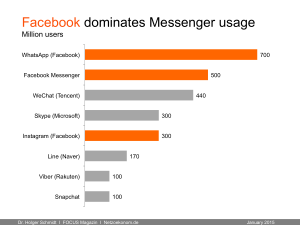
It was for the Messenger – currently the most important future project in the Zuckerberg company and now used by 500 million people for writing short messages and sharing photos. “Inventing new forms of communication – for the whole world – is a very exciting task,” said Marcus, justifying his move. Together with WhatsApp, the new acquisition costing USD 22 billion, the intention is for the stand-alone Messenger to form the central infrastructure for communication between people.
Substantial changes to Messenger in the coming year
The strategy of pressing ahead with two products in parallel is now paying off. “Due to the network effects, there is always one winner in a country. Sometimes WhatsApp is the leader and sometimes Messenger,” said Marcus. He explained that WhatsApp is more a replacement for SMS, whereas Messenger offers more functionality, e.g. sending videos. However, apparently development has still a long way to go. “If we implement our plans in the next year, the perception of Messenger will once again change completely,” he announced in an interview with German news magazine FOCUS.
Telephony function in Messenger is becoming very important
Telephony is an important component. “A substantial proportion of our users also use the app for phoning. Although we haven’t incorporated this function at all prominently, we will quickly develop the telephony function further. It is becoming very important for us,” said Marcus. WhatsApp has also announced telephone functionality that should work on any network around the world.
Earning money through communication between companies and customers
Marcus now also has a plan for Facebook to earn money from its popular communication services. “Communication between companies and our users could be an important way for Messenger to earn money. We talk about this a lot.” Facebook wants to try out a few things this year, but will probably only seriously start to turn Messenger into a revenue stream in the coming year. With the passage of time, WhatsApp could also introduce the new functionality.
Advertising is not the model for Facebook Messenger
Marcus does not care much for advertising as a revenue stream. “Messenger is a product for personal communication, and that’s not a place where people want to be flooded with advertising,” he says firmly. And Marcus also rules out developing its own payment system, its own operating system or a consolidation with WhatsApp. Marcus also does not envisage a switch from text messages to photos as a communication medium.
“More text messages will continue to be sent than photos. Most of the things that people communicate with each other are in the form of short texts, not photos,” said Marcus.
Will we soon be able to use Messenger without a Facebook account?
He wants to concentrate totally on communication. “We will develop completely new forms of communication that are not available today.” The only question that Marcus could not answer was whether Messenger will become larger than its Facebook parent. “I have no idea. Facebook is actually still growing. At the moment, Messenger is used with a Facebook identity. As long as we don’t change that, there is a limit. However, perhaps we will change that too,” said Marcus, hinting at a split from the parent.
Interview with David Marcus at #DLD15
Sie sehen gerade einen Platzhalterinhalt von YouTube. Um auf den eigentlichen Inhalt zuzugreifen, klicken Sie auf die Schaltfläche unten. Bitte beachten Sie, dass dabei Daten an Drittanbieter weitergegeben werden.

Prof. Dr. Holger Schmidt ist Experte und Speaker für digitale Ökonomie. Seine Kernthemen sind Plattform-Ökonomie, digitale Geschäftsmodelle und künstliche Intelligenz. Der Volkswirt ist Redaktionsleiter Newsletter & Verticals der F.A.Z und verantwortet das F.A.Z. PRO Digitalwirtschaft-Briefing. Außerdem lehrt er digitale Transformation an der TU Darmstadt, schreibt Bücher und ist Co-Host eines F.A.Z.-Podcasts zur Künstlichen Intelligenz.